
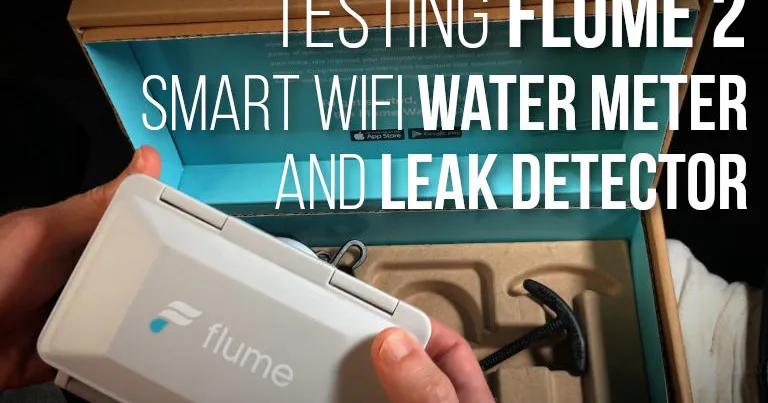
Flume 2 Water Monitor Review: 5 Years of Leak Detection
Five years with the Flume 2 water monitor: real leak alerts, a slab leak it missed, battery and corrosion issues, and what the newer Flume F2X fixes.
My rating: 4 out of 5 for the Flume 2 Smart Water Monitor
Flume 2 Smart Water Monitor Pros and Cons
Pros
- Installs on the water meter with no plumbing work and no power needed at the meter
- Flow readings matched a known volume in my bucket test
- Catches faucets left running, running toilets, and irrigation leaks
- Usage history makes unusual water use at odd hours easy to spot
- Reconnects reliably on its own after internet outages
Cons
- Misses slow, ongoing leaks like pinhole and slab leaks; it missed one that led to repiping my house
- Leak alerts need about two hours of continuous flow
- No automatic shutoff valve like the Moen Flo
- My first unit's battery packs failed early, which Flume support attributed to corrosion
I've used a Flume smart water monitor since early 2021. It's good at what it's built for: accurate whole-house water usage data and alerts for leaks like a dripping faucet. But two years ago it missed a slab leak under my foundation that ended with repiping the house. This review covers why I chose Flume, installation, how well the leak detection works, five years of long-term experience, and what's changed in the newer Flume F2X.
Why I added a smart water meter to my smart home
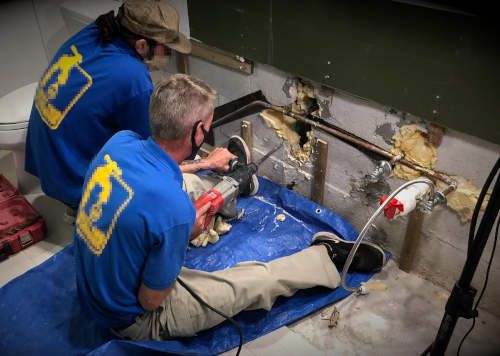
In 2020 I discovered, the hard way, an intermittent leak in a pipe run under the foundation was emitting through my bathroom wall. It left a pretty expensive mess to deal with and, due to the nature of it, was difficult to locate, since it seemed to trigger seemingly randomly, even with the help of leak detection experts.
This left me paranoid and for peace of mind I started researching to see if there were any whole-house smart wifi water monitors or leak detectors I could install. In my research I found several promising ones which I'll go over below, along with why I ultimately chose the Flume 2.
Flume vs Moen Flo, Streamlabs, and Droplet
I narrowed my list down to the Flume 2, Moen Flo, and Streamlabs. Unlike leak sensors you place under likely places a leak might occur like near a toilet or under a sink that alarm when water is detected, these all attach to the main water supply for your house allowing them to measure the water flow for your entire house.
They have intelligence to alert you to unusual water usage. The Moen Flo even has an integrated shut off valve allowing you to remotely shut off water to your house in an emergency.
The Moen Flo is the most expensive, but the integrated water shut off is worth it in my opinion and the specifications claim it can detect up to 1 drop per minute or "microleaks". It can also detect high pressure and has a temperature sensor for freeze warnings.
However, for the Moen Flo installation you need enough exposed pipe to cut your existing pipe and install the Flo and also have a nearby source of power to plug it into. The Streamlabs doesn't require plumbing, but it also needs power, and isn't as sensitive as either other option (it theoretically wouldn't be as good at finding small leaks).
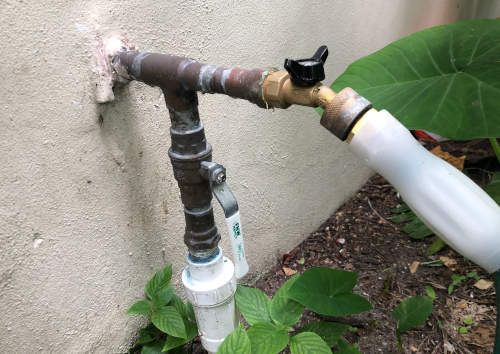
Florida houses like mine don't have power nearby the main shut off and there is no basement or crawl space to access more of the pipe than this.
A newer option I haven't tested is Droplet by Hydrific, which uses ultrasonic sensors clamped onto the main pipe instead of reading the water meter. Based on Hydrific's installation requirements, it attaches near the main shutoff and needs a power outlet within about five feet, the same constraint that ruled out the Moen Flo and Streamlabs at my house.
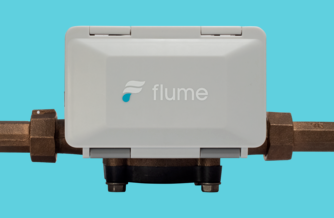
This ultimately led me to the Flume 2 because it non-invasively attaches to your water meter and is powered by replaceable lithium batteries that last for 2-4 years.
Flume 2 Installation
The below how-to video goes over my experience installing the Flume water monitor on a Tesla4 water meter. Flume claims to be compatible with about 95% of water meters in the US, but you can use the chat on their website where they can help you confirm before purchasing.
It's 5 minutes and worth your time, I promise 👇
Installation Steps
- Download the Flume app to your phone, register
- Locate the water meter in your yard
- Strap Flume alongside your water meter
- Plug the wireless bridge into power in your house that was wifi signal
- Pair using the app prompts
- Run some water from a faucet to calibrate when the app prompts you
My installation was straightforward and everything detected right away.
How does Flume work? Does it work well?
Somehow Flume reads the magnetic field of your water meter allowing it to detect, they claim, as low as .01 to .03 gallons per minute or around 1 gallon per hour which would be close to 152 drips (assuming 15,140 drips in a gallon) of water per minute without needing to invasively cut and splice the Flume into your plumbing.
How Accurate Is the Flume Water Monitor?
The first thing I did was test the flow rate by filling up the known volume of a bucket with my garden hose and was shocked that it was exactly right. Flume also let's you check the accuracy through a tool on their website from your account there by comparing meter reads at least 24 hours apart. Five years in, the usage data is still the part of Flume I value most.
Leak detection
In the first few months after installing it, Flume notified me by text and push notification that a leak was detected a few times. I immediately panicked and started looking around the house.
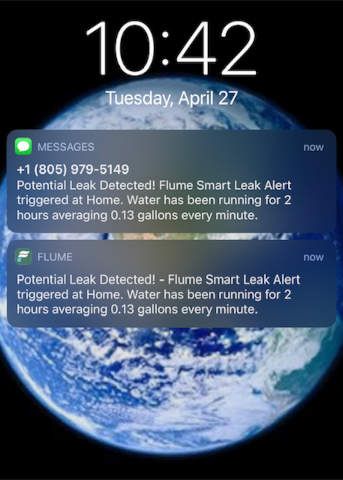
I discovered the first time was a bathroom faucet not shut off all the way and the other two were when my temporary hose-end lawn sprinkler had a constant small drip from its O-ring after it shut off. The first time, their customer service even sent me a follow up message to make sure everything was ok!
So leak detection does work, but it does require a constant detectable use for minimum 2 hours. If it is something under 1/100 of a gallon it may not pick it up automatically.
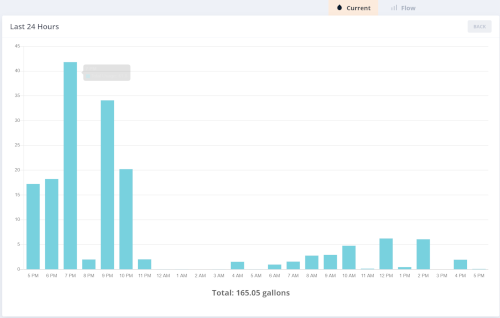
The usage chart is good for picking up usage at odd times of day. For example, if nobody was using the water in the middle of the night and you see usage that isn't attributable to maybe your ice-maker or a flushing toilet it might mean something strange is going on.
What Flume Detects Well (and What It Misses)
After five years, here's how Flume's leak detection breaks down in practice.
Great at catching:
- Faucets left running, like the bathroom faucet that triggered my first alert
- Running toilets
- Irrigation leaks, like my hose-end sprinkler dripping from its O-ring
- Unusually high usage, like a burst pipe or a large leak, which stands out immediately in the usage data
Not good at catching:
- Slow, ongoing leaks, like pinhole leaks and slab leaks under the foundation. These are the leaks that do the most hidden damage over time, and they're the kind Flume missed for me.
If slow leaks are your main worry, as they were mine, treat Flume as one layer of protection, not the whole plan.
Does Flume Require a Subscription?
No. According to Flume's help center, there are no monthly fees if you buy the device from Amazon or flumewater.com. That includes real-time usage data, leak detection, custom alerts, water budgets, appliance-level breakdowns, and API access. Flume used to sell some of these as premium features, but since April 2022 they're included with every purchase.
The exception is a Flume you get through a water utility or partner program, where features and fees can vary, so check that program's terms.
Cost savings!
When I was going over my policy with my agent earlier in the year they briefly mentioned something about credits being available for smart water monitoring devices. After I installed the Flume, I reached out to my insurance company, and they applied a credit to my policy that ended up paying for the cost of the Flume 💧🤑! If you're considering one, it's worth asking your own insurer.
Beyond that, you realize how much water certain activities use which let's you be more aware which helps to conserve. For example, hand watering the lawn exceeded my household water usage on some days which I had no idea beforehand.
Flume 2 Review: 5 Years Later
The original review was written three months after installation. Here's what long-term ownership has added.
It missed a slab leak
Two years ago I had another slab leak, and Flume never alerted me to it. That leak is what finally led me to repipe the house. Slow, ongoing leaks like this one are Flume's weak spot, and unfortunately, the type of catastrophic leak I bought it to catch is the one it didn't catch.
That doesn't make the usage data less useful, but I'd no longer treat Flume as complete protection against slab leaks. Keep checking the usage history yourself, and if you suspect a leak, call a leak detection professional rather than waiting for an alert.
Is the Flume 2 waterproof?
Flume says the sensor is waterproof, which matters because it lives in your outdoor meter box. According to Flume's support documentation, if the meter box floods and the sensor is submerged, it can temporarily lose its connection, and Flume recommends draining the box before putting the sensor back on the meter.
Waterproof didn't mean trouble-free for me, though, as the next section explains.
Battery pack failures and a replacement unit
My original unit started having repeated battery pack failures early on. Flume support attributed it to corrosion, even though I couldn't see any water inside the casing. They replaced it with a newer revision of the Flume 2 that fixed the issue, and the replacement has worked without problems for two years. I'd attribute this to early-adopter growing pains and I doubt the newer models, including the revision I now have, will reencounter this kind of failure.
Replacing the Flume 2 battery pack
The Flume 2 runs on a proprietary battery pack. On my original unit, the first pack only lasted about 10 months, part of the early battery failures Flume support attributed to corrosion. The newer revision of the Flume 2 I switched to has had much longer battery life, so battery replacement has become an occasional chore rather than a real annoyance. My Flume 2 battery replacement guide walks through it step by step with video, including recalibrating afterward, what a replacement pack costs, and the F2X's AA batteries.
Range and connection reliability
My Flume bridge is in the garage, about 50 feet from the sensor on the water meter in the yard, and the sensor has never dropped its connection to the bridge, even with the signal passing through a metal garage door.
Flume also handles internet outages well. It notifies me when it loses its connection, which has only happened when my ISP is down, and reconnects on its own once service is back.
Flume F2X: What's New
Flume has since released the Flume F2X (also called the Flume 2X). According to Flume, it adds three upgrades over the Flume 2:
- Standard AA battery packs instead of a proprietary pack. This addresses one of the most common complaints about the Flume 2. It mattered less to me because my packs lasted a long time, but it means replacements are easy to find.
- A reinforced parylene coating for better protection against water and the elements. That's aimed at exactly the kind of corrosion-related failure my original unit had.
- Upgraded Wi-Fi for faster, more reliable setup.
I haven't used the F2X myself, but if I were buying today, it's the model I'd get.
Final thoughts
After five years, I'd rate Flume 4 out of 5. It's accurate and reliable for whole-house water usage, it catches everyday leaks like a running faucet, and it's easy to install where other monitors can't go. It loses a star because it missed the slab leak it was supposed to protect me from.
Flume also provides access to your data through an API, though I haven't tested that yet, but it's important to many.
If you want one, the Flume F2X on Amazon is the current model.